
Burning [wo]man

Written in honor of Teacher Appreciation Week


Burning man allows people to come together as a community to celebrate and showcase creativity and talent. Ideally, teaching would allow and encourage the same thing, but this is not always the case. People are quick to list teachers and other community workers as people who are under-recognized and underfunded – anything more active than that is rare. This is fine. As a teacher, I don’t need to be praised for doing what I’m being paid to do…I need support from administration, coworkers, parents, and the students themselves.

There’s a reason teacher turnover is so high. In 2013, ~8.1% of teachers transferred to a different school and ~7.9% of teachers left the profession all together. There are plenty of trends related to gender, race, salary, and education level, but one of the most important indicators seems to be whether or not the teacher has a mentor during their initial time at their school. While this is great for teachers who have a present mentor, my own experience has been that I have an on-paper mentor – I have those who are listed as my mentors…but who aren’t present or approachable. As a new teacher, it is sometimes overwhelming and intimidating to confront new students, a new administration, a new school culture, and a new curriculum…and then be expected to seek out a mentor to answer questions you didn’t even know you had. As a new teacher, you are constantly reminded to not take it home. Well. Easier said than done.Picture1

It’s hard to focus on your own well being when faced with the leading causes of teacher burnout. Of the following list:

  • Teaching those who lack motivation
  • Maintaining discipline
  • Time pressure and workload
  • Coping with change
  • Being evaluated by others
  • Dealing with colleagues
  • Self-esteem and status
  • Administration and management
  • Role conflict and ambiguity
  • Poor working conditions,

I personally struggle the most with the motivation and discipline of my students and support from administration, although I’ve been faced with stress from the others at one time or another during my last two years of teaching (which are also my first two years).

I work at a school that has a mixed academic population. What does this mean? Well, half of the school is considered magnet and the other half “traditional.” The magnet students can be bused in from out of our area and are from all over the school district. The traditional students are from the local neighborhoods – thus our school is considered a Title I school. This has given us an interesting and diverse, although sometimes fractured, school culture. At this point, am I burned out? Yes. At least, for the foreseeable future. But in a few weeks I’ll have the summer and will be geared up to be burned out again by this time next year.
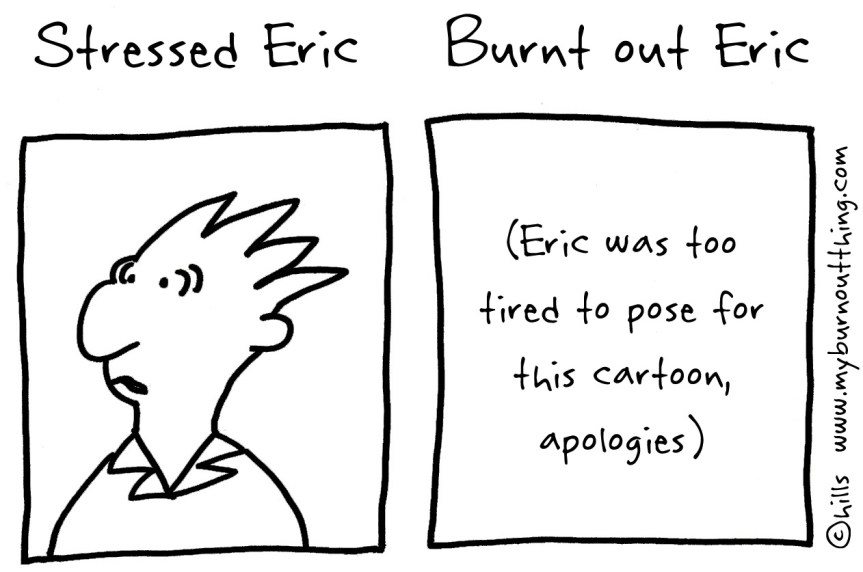
Stress-vs-Burnout

Much like Eric, I am finding myself too tired to even do my day-to-day mundane tasks. Showering is a victory while dishes lie strewn about my apartment, forgotten. Even my students have started asking “Are you okay?” I don’t really know how to answer that question when they ask. How do you say,I’ve struggled with y’all not listening to me for months now, and I’m exhausted from it. I’ve struggled with meetings, panels, papers, grading, and just balancing my life for months and am exhausted from it. I’ve struggled with staying fit and saving money and maintaining relationships, and I’m exhausted from it” 

tumblr_nmrejuy1n11sb30yoo1_500.gif

I look up like this and they draw back in fear and then I just sigh. They don’t understand the struggle that it has been to get up and drive to work. They don’t go home and take a three hour nap before being able to face just taking out the trash. I’m officially out of forks and spoons and plates…

Teaching Those Who Lack Motivation

I am lucky enough to teach seniors who say they want to go to college. They’re driven to “do what they need to do.” This, unfortunately, drives the focus away from learning and to mentalities like cheat or repeat and well is this going to be on the ACT? Just recently I gave a post-test as mandated by our district, and the first comment I was met with was “Well give us the answers. It’s good for you and your money (bonus) and good for us.” I was appalled. Even more so when they said “Well Mr. __ & Mrs. ___ & … did it, why can’t you?” Cheating is rampant throughout the school, especially with digital tools to help out, such as Group Message. One student may find the answers (whether one works it, they find the key online, or see the key on a teacher’s desk) and snaps a pic. They then use Group Message to send the photo to everyone, so everyone has the picture to copy and thus everyone has the answers to the assignment without working it. Then, when it comes to tests, they try to do the same thing (pictures to circulate of one person’s tests) or simply fail them because they didn’t do the initial work in the first place. There aren’t too many things I can do as a consequence – especially since much of this is hearsay or not directly observed. I had always loved to learn myself, so the idea that someone would cheat to circumvent that is foreign to me. I was lucky enough to have parents who loved to show us new things, to attend a high school that encouraged learning, and to be exposed to my favorite book, The Phantom Tollbooth, at an early age. The students don’t share my same motivation for knowledge, just a drive to get out and get to the magical land of college one way or another.

Many places you would like to see are just off the map and many things you want to know are just out of sight or a little beyond your reach. But someday you’ll reach them all, for what you learn today, for no reason at all, will help you discover all the wonderful secrets of tomorrow.

Maintaining Discipline

While these students are college-bound, they are still in high school, so while sometimes I’d like to just send them away forever, I can’t. I can, however, send them to the office. Which is just about as effective as wishing them away forever. Both times I wrote up a student (for blatant and severe disrespect), nothing has happened. Students (not just the ones I directly teach) will walk away when confronted by a teacher or even an administrator. Those who are suspended will miss school for a few weeks and then come back demanding their work. Students have brought guns to school with no notification to teachers, students have fought so badly they’ve knocked each other out. These are more severe examples of discipline problems, but there are smaller and more prevalent issues that are rampant throughout my classes. There’s no volume control when it comes to voices, students will talk/yell over the teacher and then complain they don’t know what’s going on. It’s exhausting to struggle with students who talk over me then want extra tutoring. You’re tasked with finding where to draw the line between being taken advantage of and doing your job. It’s stressful to both not be able to control your class, but also know that your students are 17-18 year old “adults” who just refuse to entertain the idea of respecting a teacher.

What you CAN do is often simply a matter of what you WILL do.

Administration and Management 

I know it’s dangerous to talk about this sort of thing (work) online, even on a personal blog, but I really don’t have any complaints about the personnel here. I actually like what I understand their vision for our school to be. What has been difficult for me is the turnover rate. I have taught at my school since August 2014. Since then, we have had six acting principals and many new assistant principals Having that turnover rate is difficult. Each person has their own vision for the school that they try to instill (which is good), but it’s difficult to switch methodologies, especially when they affect how we’re supposed to teach. There are a lot of different rules we have to adhere to that are good in theory, but to keep up with everything is a struggle. I try my hardest to not bring my work home, but sometimes, even if the papers don’t follow me, the worry does. I worry what if I’m not fulfilling their expectations, what if I won’t be considered effective, what happens if I am considered ineffective? Will I be asked to return to my position? Will I have a job next year?

Whether or not you find your own way, you’re bound to find some way. If you happen to find my way, please return it, as it was lost years ago. I imagine by now it’s quite rusty.

BalanceBurnout is a very real psychological stressor that many teachers experience. I feel like I’m on a one-way train to exhaustion via frustration and cynicism. I want to be happy and really enjoy my job, but sometimes it’s difficult. I am a social introvert, so dealing with so many people on a daily basis is already difficult, but when I struggle with maintaining control of the classroom while fulfilling the duties given to be by the school it’s even harder. I don’t dislike teaching. In fact, there are many times that I really really enjoy it, but the problems associated go beyond not being recognized or having to buy supplies myself. A lot of it is recognizing burnout and being supportive when you see it. Understanding that the small victories of doing laundry and sweeping the kitchen are enough for now, and that to ask any more of us before summer is just too much.


Sources:

Designation Title I

I originally wrote this post back in May. It was after a mass cheating in my advanced math class resulted in giving 52 zero’s on their final exam. The resounding motto I heard in response was “Cheat or Repeat.” I still need to become more educated about what the new changes the “Every Student Succeeds Act” will bring to have an informed opinion, but the following is a [long] post about my opinions of the results of No Child Left Behind and and its shortcomings.


In many discussions about education, Title I has become a buzzword. Other hot topics in education, such as Common Core, show similar discourse, which leads to the following question: Do people actually understand what they are debating? Common Core is another topic entirely, but the amount of similar misinformation raises the question of whether Title I has been defined beyond the established stereotypes of dangerous, ghettorun-down, and undesirable.

Terminology

AN ACT To strengthen and improve educational quality and educational opportunities in the Nation’s elementary and secondary schools.

April 11, 1965 (H. R. 2365) Public Law 89-10

Title I is no new designation; it was created in 1965 by the Elementary and Secondary Education Act (ESEA). In the initial documents, it is stated that this should provide financial assistance to local educational agencies for the education of children of low-income families. In less subjective layman’s terms: public/private schools who have a population of 40% or more students from lower-income families (as designated by the US Census) are eligible to be considered Title I as per the US Department of Education. This means these schools can receive federal funding distributed through state agencies (e.g. department of education, district offices). Priority is given to schools making an effort to improve their performance but that have less funding and lower-achieving students.

When not given context, this definition has led to criticism. For instance, why should federal funds be used at the state level to fund schools based on a child’s fiscal situation? Students from lower-income families and communities are simply more at risk when placed in a school that is also disadvantaged. They have been exposed to emotional and social challenges, acute and chronic stressors, cognitive lags, and health and safety issues by virtue of their socioeconomic status. These students may have also been exposed to stressors as English as a Second Language (ESL) students or students from intervention programs who have experienced neglect or abuse.

It was clear even during the 1960’s that there were strong ties between school performance and the socioeconomic status of its students. There was a large gap between the performance of the two groups, and so ESEA was initially created to bridge the literacy/mathematics gap between disadvantaged children and those from more privileged households. There are countless studies, papers, and books on this subject. This sounds reasonable, so why are people upset about this? They probably are okay with the aspect of educating at-risk children, but this is where those stereotypes of ghetto and run-down have come from. Ghetto, specifically meaning a slum area of minorities, is an area that will have students who are at-risk and who may have behavioral problems. It is a lower-income area, so the schools will have less money, lower performance, and kids at risk of failure, abuse, or both.

No Child Left Behind

No Child Left Behind (NCLB) is an extension of ESEA (which needs to be renewed every five years and has been since its inception). Many teachers, administrators, and parents who have criticisms for the Title I status are actually at odds with additions made by NCLB, not with the foundation that ESEA laid. Each school must make Adequate Yearly Progress (AYP) as determined by several factors with consequences for failing at different intervals and in different areas. This portion of NCLB allows schools to be held responsible using quantitative data, which can be found on a school’s “report card.”

  • Percentage of students scoring at each proficiency level of state’s assessment (by subgroup)
  • Comparing school/district’s performances to state’s AYP goals
  • Percentage of students not tested
  • Two-year trends
  • Other indicators for AYP (as specified by state)
  • High school graduation rates
  • Teacher qualifications
  • If school is identified by the state/district for improvement

Being able to track this data is invaluable and allows the federal government (and state government) to make more educated decisions; however, it does come at a price.

Falling through the Cracks

While there is strong motivation and support to meet the lowest bar, there is virtually no support for students who are capable of achieving above and beyond. No incentives currently exist to create programs to foster students once they have reached the boundary of functionality as determined by the respective state, and there are no required programs for gifted students under NCLB. This does not mean they do not exist – some states have gone above and beyond to make sure their students are afforded these educational opportunities, but this is the exception, not the rule. Most states experienced severe cuts to the funding of gifted programs once it was clear they were not a federal priority.

Another concern is the shift of funding onto almost solely literacy/mathematics versus other subjects such as history, art, science, foreign language, and music. As a mathematics teacher who taught seniors how to work with negative numbers and fractions, I know that it is vital to teach our students how to analyze written work and analytically work with word problems; however, this has statistically been shown to be done at the expense of other subjects because of the risks associated with not reaching the bars set by NCLB, which requires 100% compliance and achievement.

Lastly, students with disabilities or who are (ESL) are being left behind in terms of useful data collection. What does this mean? Unlike with gifted students, NCLB does give incentives for schools to provide for students who need special accommodations as per their IEP/504 plans. Unless a students’ IEP/504 plan specifies otherwise, the student must take the same assessment as the general population.The amount of useful data that can be collected is at risk because the NCLB requires their data to be counted just as other students’ scores. This makes it difficult, if not impossible, to use data gathered from testing and the like to make decisions for the benefit of this group. These students’ disabilities also vary greatly in degree and classification, so their data being mixed in with the general students’ can skew it and compromise its integrity and usefulness.

One Size Fits All

NCLB’s requirement is for 100% compliance – meaning 100% of a school’s students must participate. ESEA’s original intention back in 1965 has stayed – level the playing field for disadvantaged children by not leaving them behind; however, by acting as if each child is a cookie cutter of the one before, it makes the system less effective and puts strain on the child, teacher, and parent. When a child is told they should be capable of something and they are not, it puts psychological strain on the child. It puts emotional strain on a parent to be told their child is not performing at level and should be. And it takes a toll on the teacher to be told that the child should  be learning this. This leads to all three questioning their competencies for not completing an impossible task. This also leads to schools operating under increased pressure and being put at risk of penalties for not being able to raise the achievement of students who do not have the capabilities necessary to perform at the level the state has mandated.

Playing the Game

After looking at the population of students who are being left behind just by nature of the system, the focus on data and terminology allows “creative” administrators and faculty to manipulate their data to avoid reprimand and maximize awards. Even outside of manipulating the data, the NCLB requires 95% of students to be assessed and up to 1% of students can be just declared proficient based on an alternative assessment. The data in some cases has been manipulated due to outside funding from for-profit sources.

Closing Remarks

As an educator, parent, or citizen, knowledge of what the actual shortcomings of NCLB and how they can affect a Title I school, and knowing what a Title I school actually is, is vital to engineering the success of a student. Many of the Title I schools are in run-down areas. Many of them are desperate for funding, have students who already have a criminal record, and have students who are incredibly disadvantaged, abused, at risk, and in need of support. The NCLB addition to the ESEA is in no way perfect, and it puts a lot of strain on the people involved. Its positives are fairly obvious and have been consistent for almost sixty years – provide funding for schools who have high populations of students in need to bridge the gap between them and students who are more privileged. The short-comings…the students who fall through the cracks, the pressures that children, their families, and their educators are put under, and the simple fact that schools are being driven to a lack of integrity to meet a quota are all causes for concern and discourse.


Sources:

The Fraction Faction

mathpics-mathjoke-mathmeme-pic-joke-math-meme-haha-funny-humor-pun-lol-dog-denominator-digging-holes

There is nothing worse than finishing up the chapter, allowing your students to work on the study guide for their first class in groups during class…and then realizing that your twelfth graders have no idea how to add fractions together. Which means their trouble with the implied domain of functions involving fractions makes way more sense.

It is frustrating when the problems my students are going through are not because of the concepts we are learning, but because of gaps in their knowledge from the last three years of their education. At this point (when I posted this on FB), there were many defenders of my dear seniors. I still don’t know how to do fractions – I never learned!” “Well, sometimes it’s hard because the teacher doesn’t make it interesting or relevant.” Well, it is close to the beginning of the school year [actually the 6 weeks just ended] so they probably forgot a lot over the summer.” And my personal favorite Thanks Common Core.” 

Well. Firstly – as a teacher I simply don’t have the time to glitz every single lesson to make it completely relevant and interesting to every single student. The point is that you’re in school, you learn it, you study, you do well. Secondly, you don’t forget every single thing you’ve ever learned in your life over a month and a half. Thirdly, they should have learned fractions in elementary/middle school – well before Common Core (which I do support) came into their schools. So where is this breakdown occurring? My personal opinion is that the guidelines that No Child Left Behind places on schools causes pressures to just pass children through – so you end up with a student performing at the 9th grade level in 12th grade math; however, how they got in my class with the skills they possess is not something I can control. What I have to do is scaffold them until they have these vital skills.

The kids I teach are college-bound. They are a part of an engineering magnet, so it is reasonable that I expect them to hone their advanced mathematics skills to prepare them for college. It is difficult to maintain faith in the future of my students, because they are going into math-centric fields without the necessary tools to do well and succeed. Since we’re a little ahead of the other teachers who teach the same subject, I am going to take the week following their chapter one test to focus on the skills they should have learned from their previous teachers. I keep telling myself that it doesn’t matter that they should have anything. If they didn’t, we need to get them back up to level.

I guess this was really more a reflection and rant? It gets discouraging to not be able to continue on a topic because of a lack of knowledge. That you can know how to take a composition of a function, but don’t know that you shouldn’t add x+ x. I’ll have to suck it up and do a review of these fundamentals…because they deserve a brighter future, and so do we.